6 May 2026
Top Reasons to Barcode on the Shop Floor
Paper timesheets, manual entry, and guesswork have real costs — wrong job charges, payroll errors, and no clear picture of what is actually happening on the floor. Barcode scanning in Standard Time® fixes all of it. Here is why manufacturers make the switch.
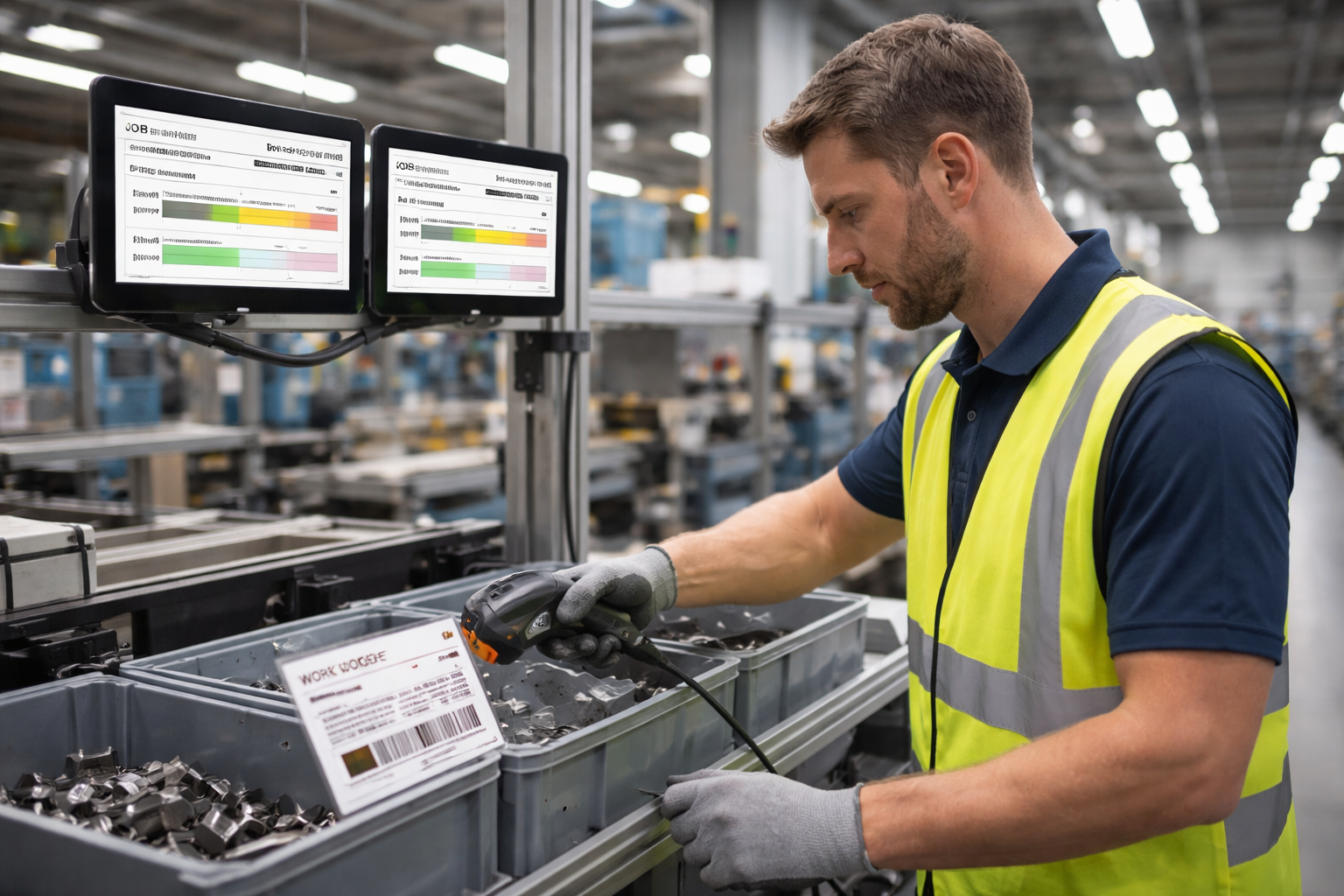
Eliminate Manual Data Entry
Every keystroke is an opportunity for error. When employees type in job numbers, task codes, or time values by hand, mistakes are inevitable — and correcting them costs supervisors hours every week. A barcode scan is binary: it either reads correctly or it does not. There is no mistyped work order number, no wrong employee ID, no transposed digit. The data that reaches Standard Time® is exactly what was on the label.
Clock In and Out in Seconds
Asking employees to navigate software menus or fill out forms before they can start working creates friction and delays. A barcode scan takes under a second. Employees scan their badge, scan the work order, scan the task — and the timer is running. At the end of the job, two more scans and they are clocked out. The entire sequence takes less time than unlocking a phone.
Tie Labor Hours Directly to Work Orders
When time tracking is disconnected from job tracking, labor costs get averaged across projects instead of attributed accurately. Barcode scanning links every minute of work to a specific work order at the moment it is performed. Job costing becomes precise — you know exactly what each order cost in labor, not an estimate based on headcount and shift length.
See Who Is Working on What, Right Now
Without real-time data, a supervisor's only option is to walk the floor. With barcode scanning feeding Standard Time®, the Work In Progress view shows every active employee, every open work order, and every task in progress — updated live. Questions like "where is that order?" and "is anyone on job 1042?" get answered from any browser without leaving the office.
Build a Timestamped Audit Trail Automatically
Every barcode scan writes a record: who scanned, what was scanned, and when. Over time this creates a complete, unedited history of labor activity — useful for customer billing disputes, warranty claims, compliance audits, and process improvement. No one has to remember to document anything. The act of doing the work creates the record.
Speed Up Payroll with Accurate Time Data
Payroll bottlenecks often trace back to collecting and reconciling timesheet data at the end of the pay period. When every clock-in and clock-out is captured by a barcode scan throughout the week, Standard Time® already has accurate totals waiting when payroll runs. No chasing down late timesheets, no manual reconciliation, no rounding disputes.
Identify Bottlenecks with Real Process Data
When employees scan the specific task or process step they are performing — welding, assembly, inspection, packaging — Standard Time® accumulates detailed time-per-step data across every job and every shift. Patterns emerge: which steps consistently run over estimate, which operators are fastest on which tasks, where WIP piles up. That data drives real process improvements rather than gut-feel decisions.
Retire Paper Timesheets for Good
Paper timesheets get lost, smudged, filled out from memory at the end of the shift, and interpreted differently by whoever enters them into the system. They are a bottleneck between work happening and data existing. Barcode scanning on the shop floor makes the timesheet redundant — the data is already in Standard Time® by the time the shift ends, accurate to the second.
What You Need to Get Started
- A Standard Time® subscription (Pro or Enterprise)
- A USB or wireless barcode scanner — any scanner that outputs text works
- Printed barcode labels for employee badges, work orders, tasks, and a STOP label
- A tablet or PC at each scanning station
Most shops are scanning within a day of setup. No custom hardware, no proprietary scanners, no lengthy integration projects.